
Most developers think "open" simply means open-source. When it comes to what is AI coding tool openness, that assumption gets you into trouble fast. Openness in AI coding tools covers source code access, model weight availability, documentation quality, data transparency, and the governance controls that let you audit and trust what the tool actually does. Get any one of those wrong, and you're coding blind, whether that means shipping AI-generated bugs you don't understand or running agents that execute destructive commands before you've approved anything.
Table of Contents
- Key takeaways
- What AI coding tool openness really means
- Transparency and collaboration in AI coding tools
- Security considerations and AI coding tool governance
- Real-world examples of AI coding tool openness
- Applying openness principles in your workflow
- My take on what openness really demands from you
- How Descry fits into a secure, open AI coding workflow
- FAQ
Key takeaways
| Point | Details |
|---|---|
| Openness is a spectrum | AI coding tool openness spans code, weights, documentation, and data, and rarely covers all four at once. |
| Transparency builds accountability | Disclosing AI tool use and reviewing AI-generated code keeps human developers responsible for every line merged. |
| Pre-trust execution is dangerous | Agents that run code before user approval create arbitrary code execution risks that trust dialogs alone cannot fix. |
| Governance layers are non-negotiable | Approval gates, sandbox controls, and fail-closed timeouts are the practical controls that make open AI tools safe to use. |
| Local-first architecture reduces exposure | Tools that operate on-device without cloud accounts limit data leakage and strengthen your security posture. |
What AI coding tool openness really means
The phrase gets used loosely, and that looseness causes real problems. AI openness involves multiple dimensions rather than a simple open-or-closed binary. Think of it as a dial, not a switch.
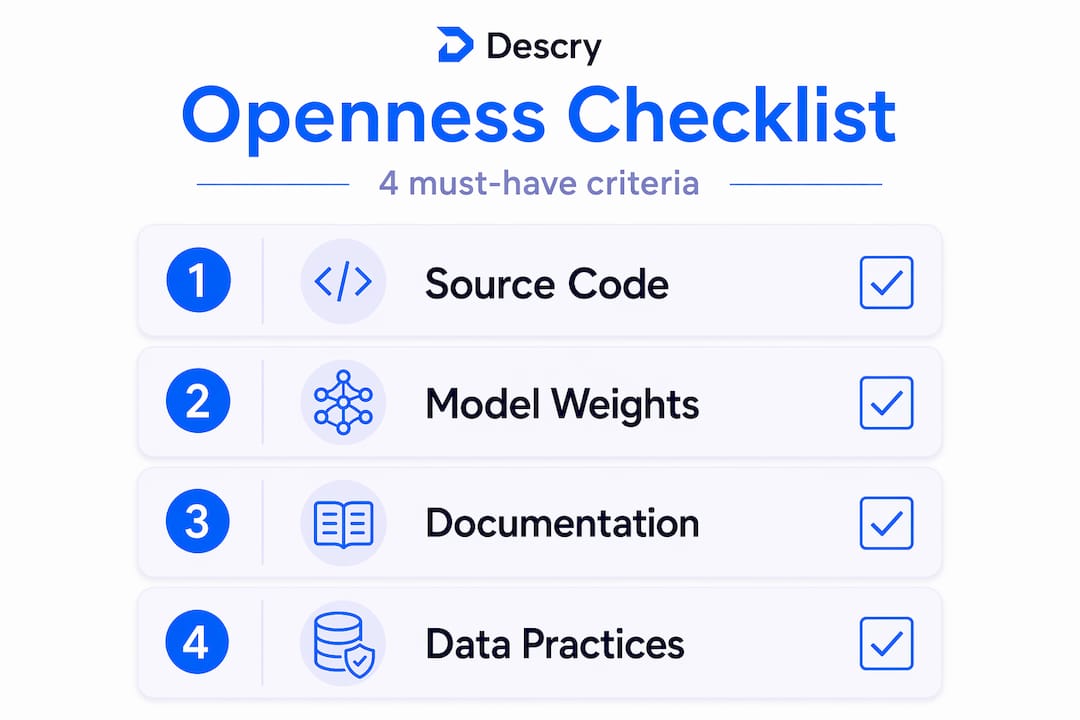
Here are the four dimensions you should evaluate every time you assess an AI coding tool:
- Source code availability. Can you read, fork, and audit the code that powers the tool? Open-source tools published under licenses like MIT or Apache 2.0 let you inspect what the agent is doing under the hood. Proprietary tools do not.
- Model weights. Is the underlying AI model publicly available? Open-weight models let security researchers probe for vulnerabilities and biases independently. Closed-weight models require you to trust the vendor's word entirely.
- Documentation and usage policies. Does the tool publisher explain how the model was trained, what data it consumed, and what the tool will and will not do? This dimension often separates trustworthy tools from marketing-heavy ones.
- Data transparency. Does the tool collect your code, queries, or context for training purposes? Tools that state explicit no-data-collection policies give you a fundamentally different risk profile than those that log everything.
Licensing adds another layer of complexity. An MIT license on source code means very little if the underlying model weights are proprietary or the training data is undisclosed. You can read the plumbing but you still cannot fully evaluate the water. This is why the marginal risk-benefit analysis the OECD recommends is so useful. It forces you to ask: "What exactly is being made open here, and what remains hidden?"
Pro Tip: When evaluating an AI coding tool, create a simple four-column checklist: source code, model weights, documentation, and data policy. Score each dimension 0 to 2 based on what is actually disclosed. Any tool scoring below 4 total deserves extra scrutiny before you let it touch production code.
Transparency and collaboration in AI coding tools
Transparency is not just about what the tool makes public. It is about the practices your team adopts when using AI assistance. The benefits of AI coding tools only materialize when you build clear disclosure norms into your workflow from day one.
Consider what this looks like in practice:
- Disclose AI tool use in commit messages and pull requests. Policies like those adopted by the OpenCue project require full disclosure of AI assistance so that peer reviewers know which code to scrutinize more carefully.
- Require human review of all AI-generated code. The principle here is non-negotiable: AI cannot autonomously merge or approve PRs. A human developer must fully understand and stand behind every line before it ships.
- Use AI assistance as a starting point, not a final answer. Treat generated code as a draft from a junior colleague who sometimes confidently writes broken logic. Review it, run your tests, and ask the tool to explain any section you do not immediately understand.
- Document your AI tooling choices in your project README. This helps onboard new contributors and creates an audit trail for compliance purposes when that conversation comes up with your security team.
Why does this matter for collaboration specifically? When disclosure and review norms are in place, teams can distribute AI-assisted code contributions without creating knowledge silos. The developer who wrote the PR and the developer reviewing it both have equal context. That symmetry is what keeps AI tools from becoming black boxes that only one person on the team understands.
Pro Tip: Add a single line to your PR template: "AI-assisted: Yes / No. If yes, list the tool used." This tiny addition creates accountability without adding friction.
Security considerations and AI coding tool governance
Here is where things get genuinely dangerous if you are not paying attention. Understanding the features of AI coding tools means understanding not just what they can do, but what can go wrong before you have a chance to stop it.

Pre-trust execution risk
The most serious vulnerability in many agentic coding tools is not what happens after you approve an action. It is what happens before. Common agent security failures occur during workspace bootstrap, when the agent parses and executes workspace-controlled code before user trust is confirmed. This creates an arbitrary code execution window. A compromised dependency or a malicious workspace configuration file can run code on your machine before you have seen a single approval dialog.
Trust dialogs alone are insufficient governance. Effective security requires either sandboxing execution during the bootstrap phase or delaying any execution until after user approval is explicitly granted.
Governance patterns that actually work
The table below shows how secure AI coding tool governance separates low-risk from high-risk operations:
| Operation type | Risk level | Governance approach |
|---|---|---|
| Read files, search code | Low | Auto-approved, logged |
| Write or edit files | Medium | Confirmation required before execution |
| Delete files, run scripts | High | Explicit approval with timeout |
| Network requests, installs | Critical | Deny-by-default unless whitelisted |
Human-in-the-loop confirmation gates with fail-closed timeouts implement exactly this kind of permission hierarchy. If the user does not respond to an approval dialog within a set window, the action is automatically denied rather than automatically approved. That single design decision eliminates an entire class of unattended execution risk.
AI tool transparency also connects directly to public sector security guidance. The UK government's framework on open code in sensitive environments explicitly links openness to security controls: no committed secret keys, secure-by-design architecture, and mandatory security review before any open-code deployment. Those standards are worth adopting even if you work in the private sector.
Pro Tip: Set up zero trust security principles for every AI agent in your workflow. Never assume a tool is safe because it is open-source. Verify its permission model, test its approval gates, and sandbox it before you grant it access to any sensitive repository.
Real-world examples of AI coding tool openness
Seeing how openness principles work in actual tools makes the concept concrete. Here is a breakdown of tools and frameworks that demonstrate the spectrum in practice.
OpenCode is a strong example of what open-source AI coding tools can look like when openness is built in by design. It runs locally, supports multiple AI models, and explicitly collects no data. You can integrate it into your terminal or IDE, inspect every line of its code, and swap out the underlying model without being locked into a vendor. That flexibility is exactly what the open ecosystem approach enables: managing agent workflows across platforms without governance gaps.
Governance-focused agent toolkits take a different but complementary approach:
- Permission tiering. Read-only operations are auto-approved and logged. Write, edit, and delete operations require explicit user confirmation before execution.
- Fail-closed timeout logic. If the user does not confirm within a defined window, the operation is denied, not silently skipped or retried.
- Audit logs. Every agent action, confirmed or denied, is written to a log that developers can review after the fact.
- Scope declaration. The agent must declare what operations it intends to perform before executing any of them, giving the developer a preview rather than a surprise.
Microsoft's work on agent safety goes even further by recommending that continuous safety testing be built into CI/CD pipelines. The idea is that red-team knowledge becomes repeatable automated tests that run on every build. That approach transforms security from a one-time audit into an ongoing practice.
Applying openness principles in your workflow
Knowing what AI coding tool openness means is useful. Knowing how to apply it is what actually protects you. Here is how to translate these principles into daily practice:
- Audit every AI tool before adoption. Check source code license, model weight availability, data collection policy, and permission model. Reject tools that cannot answer all four questions clearly.
- Set workspace trust boundaries explicitly. Do not let any AI coding agent auto-approve write or delete operations. Configure approval dialogs as the default, not an optional setting.
- Require AI disclosure in your team's contribution guidelines. This is not bureaucracy. It is the foundation of accountability in AI-assisted development and makes code review meaningfully more effective.
- Integrate vulnerability scanning into your pipeline. AI-generated code introduces patterns that static analysis tools may not catch without recent rule updates. Keep your scanners current.
- Align with your organization's AI policy. Many teams have no formal AI policy yet. If yours is one of them, use the UK government's open-code security framework as a starting template.
Agent permission models that balance auto-approved read-only operations with confirmation-required write operations give you the practical control layer that makes openness sustainable rather than reckless.
My take on what openness really demands from you
I've been watching how developers approach AI coding tools for a while now, and the pattern I see most often is this: teams celebrate the "open-source" label and skip the harder questions entirely.
What I've learned is that openness without governance is just exposure. A tool with a public GitHub repository but no approval gates, no audit logs, and no clear data policy is not meaningfully open. It is just undocumented risk. The teams I've seen handle this well treat openness as a checklist with four columns, not a marketing checkbox.
The uncomfortable truth is that most trust dialogs in AI coding tools were designed to manage legal liability, not to protect your codebase. They tell you something is about to happen. They rarely stop it fast enough. Real protection comes from pre-execution evaluation, not post-approval logging.
My advice is to stop asking "is this tool open?" and start asking "what is this tool transparent about, what governance controls does it expose, and what happens when I do not respond?" Those three questions will tell you everything you need to know about whether a tool belongs in your workflow.
— Maciej
How Descry fits into a secure, open AI coding workflow
If you have made it this far, you understand that transparency and security in AI coding tools are not competing priorities. They require each other. Descry was built on exactly that principle.
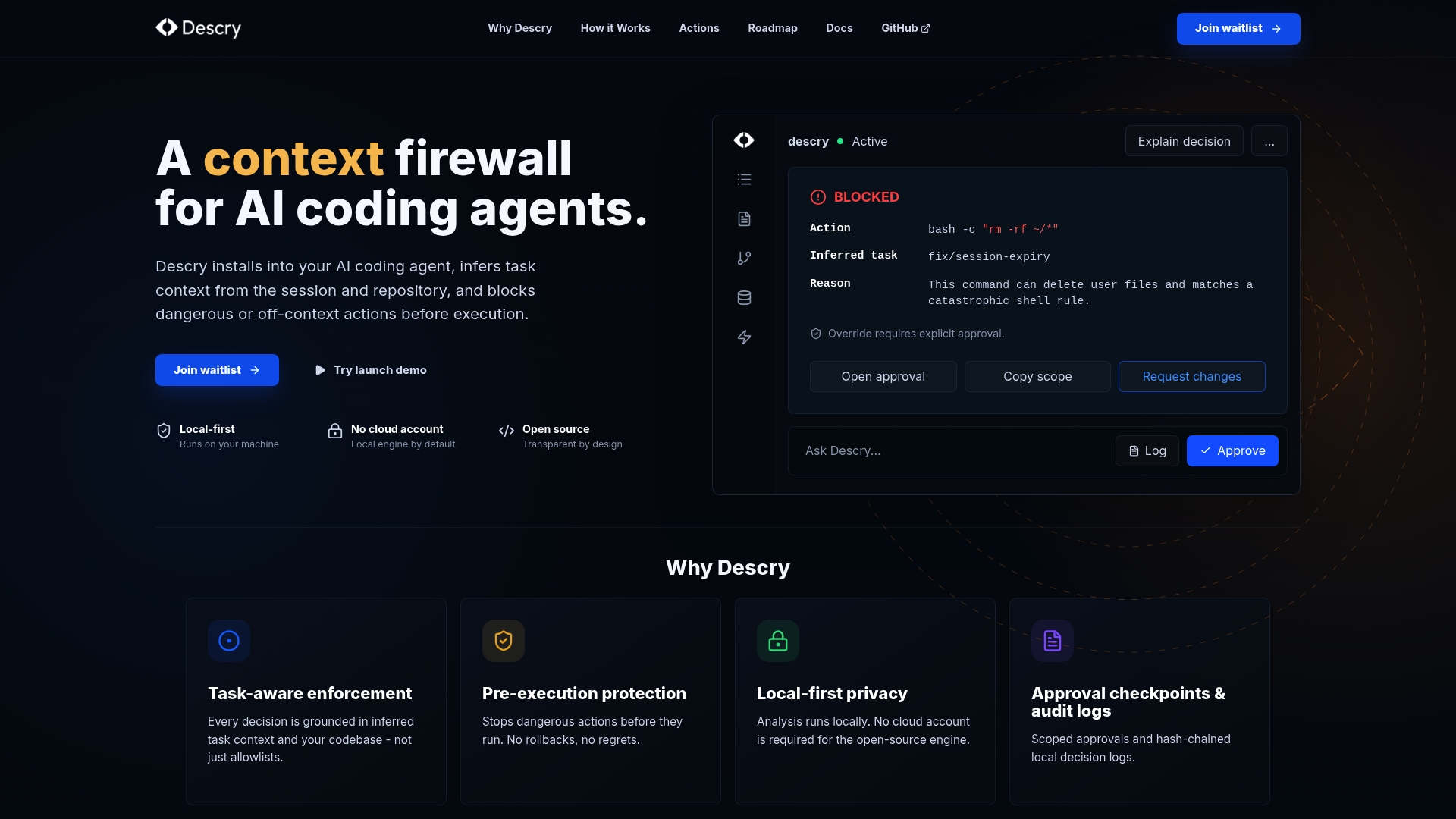
Descry operates as a context firewall for AI coding agents, running entirely on your local machine without requiring cloud accounts. It evaluates every agent action before execution using inferred context from your codebase, current tasks, and recent actions. Dangerous commands get flagged before they run. Approval checkpoints give you clear visibility into what the agent intends to do. Audit logs let you review everything that happened after the session ends. For developers who take AI coding tool openness seriously, Descry provides the governance layer that turns transparency into actual security.
FAQ
What is AI coding tool openness?
AI coding tool openness refers to how much of a tool's source code, model weights, documentation, and data practices are publicly disclosed and auditable. It is a spectrum rather than a binary state, and each dimension carries different implications for security and accountability.
Why does transparency matter in AI coding tools?
Transparency allows developers to audit AI-generated code, understand tool behavior, and maintain accountability for every line that ships. Without disclosure practices, teams lose the ability to meaningfully review contributions or trace errors back to their source.
What is the biggest security risk in agentic AI coding tools?
Pre-trust execution is the most dangerous vulnerability: agents that parse and run workspace-controlled code before the user has granted explicit approval. Trust dialogs alone do not solve this. Sandboxing and delayed execution are the practical controls that actually prevent arbitrary code execution during bootstrap.
What are human-in-the-loop confirmation gates?
These are approval checkpoints that require explicit user confirmation before an AI agent executes write, edit, or delete operations. Effective implementations include a fail-closed timeout, meaning the action is denied automatically if the user does not respond within the defined window.
How should developers choose between open-source and proprietary AI coding tools?
Evaluate each tool across four dimensions: source code license, model weight availability, data collection policy, and permission model. Open-source tools offer auditability but require governance controls to be safe. Proprietary tools may offer stronger managed security but limit independent evaluation. The best choice depends on your threat model and compliance requirements.